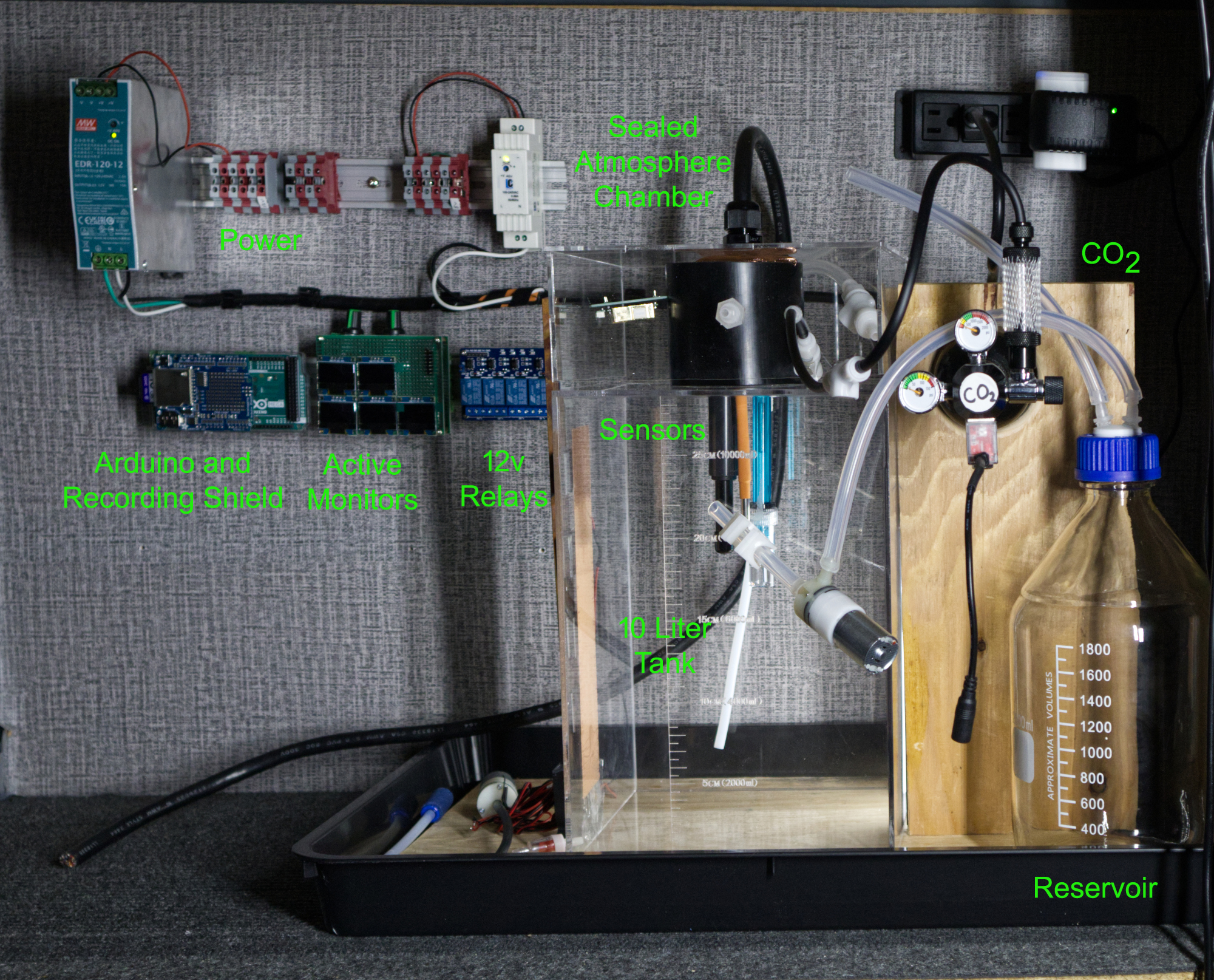
The project began with the idea of monitoring the CO2 uptake of eelgrass (Zostera Marina) as it grows. It has since expanded to monitoring much more than CO2 and has become a true bioreactor for controlling any parameter necessary in seawater.
The experiment is done in a rack in my garage. That gives me some ability to limit stray light and keeps it cool enough that my peltier cooler doesn’t have to work too hard.
I decided to enclose the sensor’s connections to their instumentation amplifiers in a 4″ diameter ABS pipe. I did this for a couple of reasons: First, the sea air in the atmospheric chamber will be corrosive and second, I needed to isolate the sensor signals from the electromagnetic interference (EMI) that the selenoids, pump motors and relays would create.
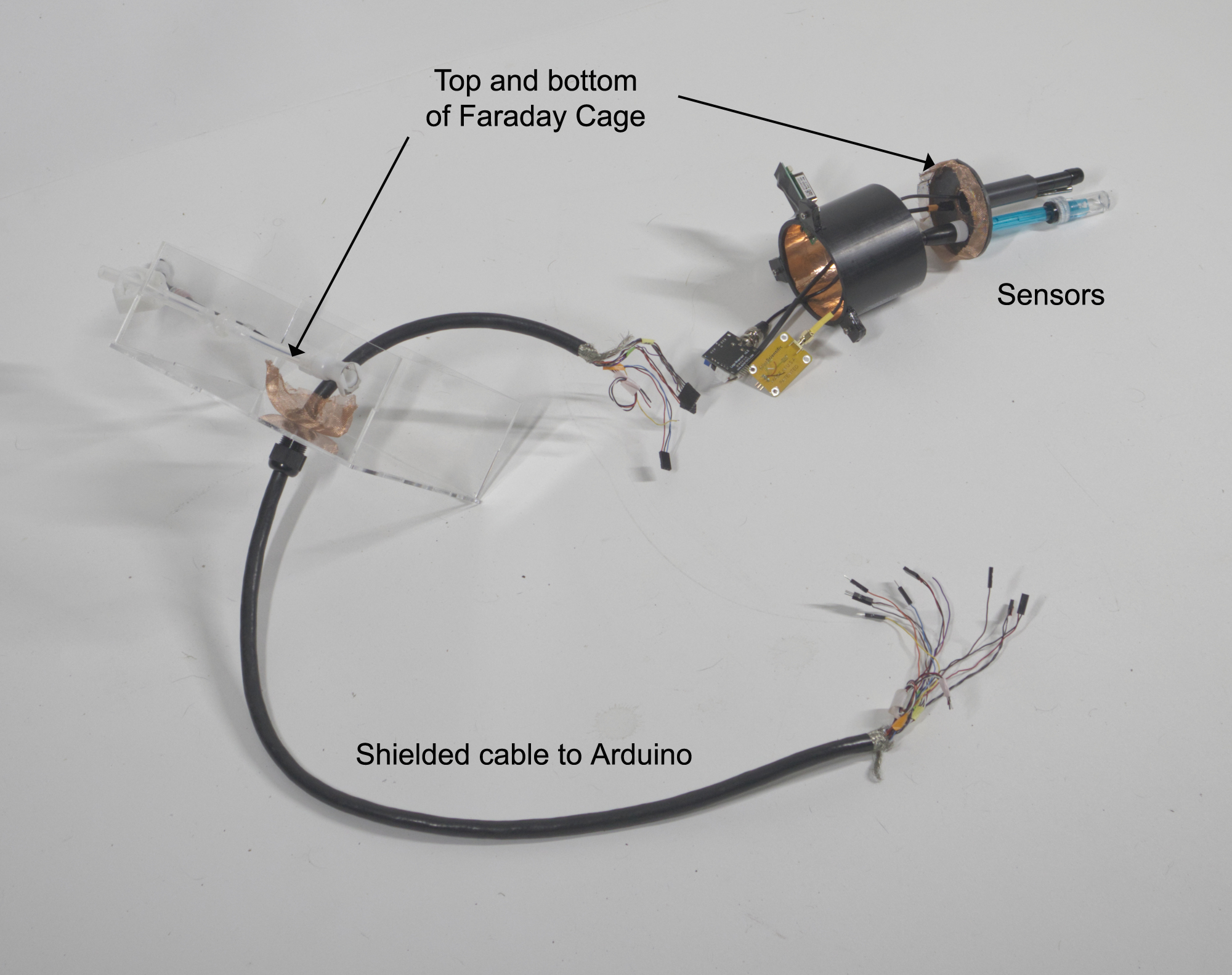
The inside of the 4″ ABS sensor block is lined with copper tape which will be grounded to act as sheilding from any outside interference with the signal. The amplified signal is then fed to an Arduino MEGA by a shielded cable wich is also grounded.
The reservoir and water pump system has quick release connections that allow me to siphon off samples using a 150 mL syringe to test nitrate levels, salinity, and to calibrate the sensors.
The Peltier cooling of the water uses 4 Marlow Peltier devices. They work best at 3 vots and 6 amps of power. The DIN rail power supply is 12 volts and 10 amps. I’ve run the peltiers in series so the voltage divides into 3 volts each. The fans, pump motors and actuator for the CO2 are connected in parallel and should lower the power reaching the Peltier devices to about 8 amps (untested).
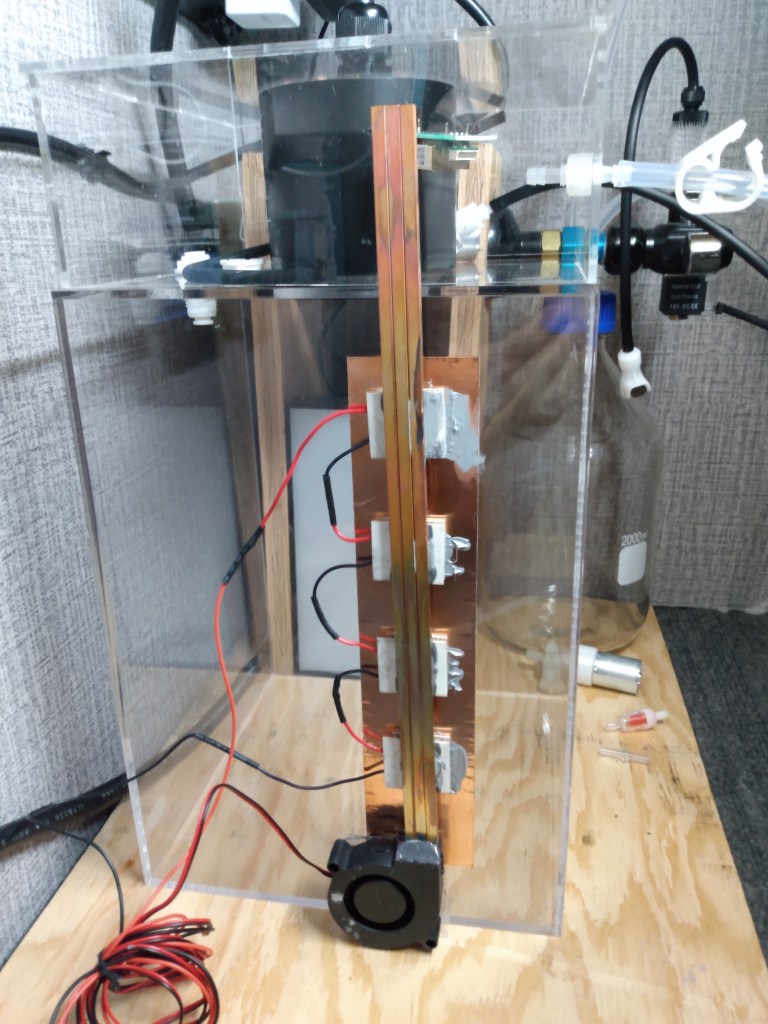
It works incredibly well but I still plan on adding a secondary cooling unit to the back of those pipes you see that the blower pushes air through.
Most of the bioreactor can’t be autoclaved so I’m using a UV wand I built during COVID for a lot of the santization.
 jzahir
Recent Comments