Home

Hobby: Score for my first script

Leave a comment

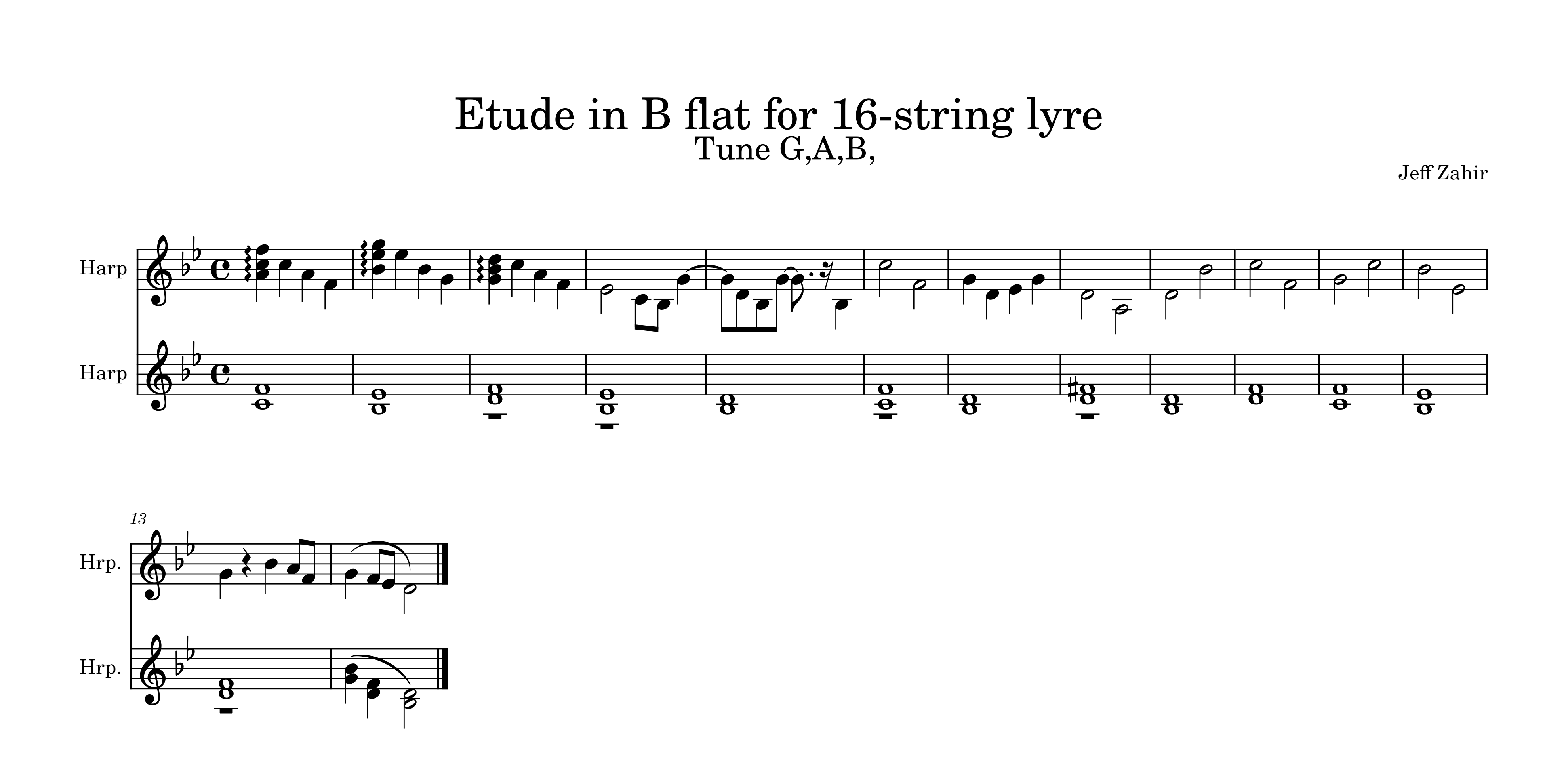
The main theme uses Orpheus’ Lyre. It starts in B flat major then changes to darker modes as he gets closer to Hades.
Scene when Orpheus is on the shore of the river Styx and sees Charon’s boat approaching through the mist over the river.

Scene when Orpheus enters Hades’ temple and we see Hades on his throne reading prayers of the deceased that were burned on funeral pyres. On each side of the throne is a brazier; one for “Granted” and the other for “Denied”. Shadows flow over the floor’s surface until they reach the lit area around Hades. From the shadows, long arms shrouded in floor-length dark sleeves rise with the prayers on paper and hand them to Hades. The first cresendo is when we see Hades and the second for when he decides and tosses the paper into one of the braziers.
Hobby: My first script

Leave a comment

I wrote a script in October, 2024 about the Greek legend of Orpheus and Eurydice based on Virgil translated from the Latin.

Logline:

Scion of Apollo Orpheus and a water nymph Eurydice are celebrating the first day of Spring with friends in a glen when Eurydice dies from a snake bite. Orpheus travels to Hades to retrieve his bride and is thwarted by Hades’ wife Persephone and his own hubris.

Project Bioreactor: Sea Water Collection and Sterilization System

Leave a comment

I live 3 miles away from a boat launch on the very southern tip of Puget Sound. The launch is adjacent to seagrass meadows that are the subject of my investigations.

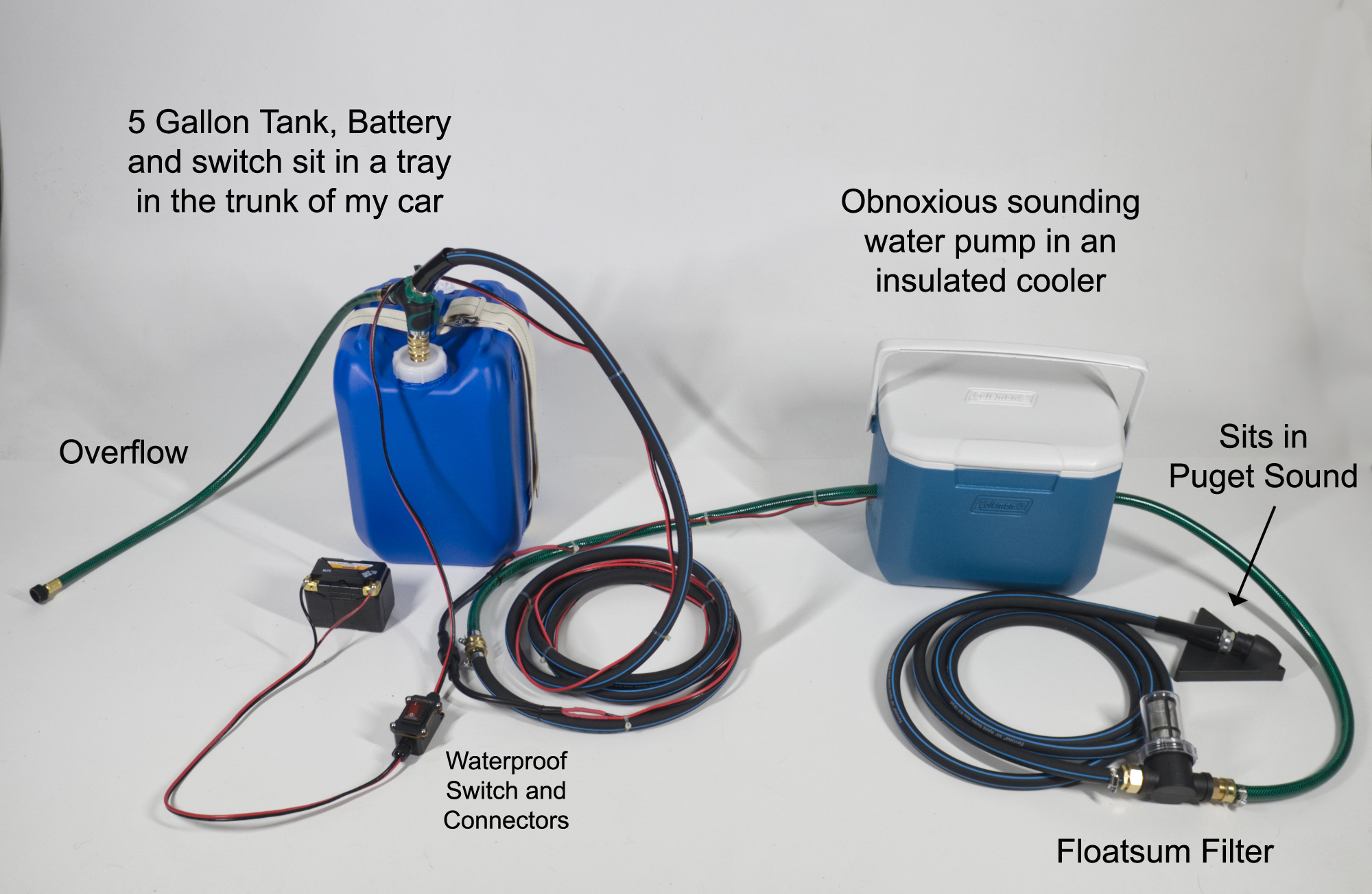
In order to get the same sea water as the meadows, I built this system for pumping 5 gallons of sea water into a tank that’s strapped into the back of my Volkswagon Beetle. The setup should take no more than 5 minutes and the pump is advertised to pump 1 Gallon per minute.

I’ll collect water at high tide but I’m worried about clogging the pump so I’ve installed a filter along the hose leading to the pump’s intake and I’ll probably fasten a Whiffle Ball to the business-end of the intake hose.

Once I’ve sterilized the tanks and everything that will come in contact with it, I’ll need to sterilize the sea water I’ve collected from Puget Sound.

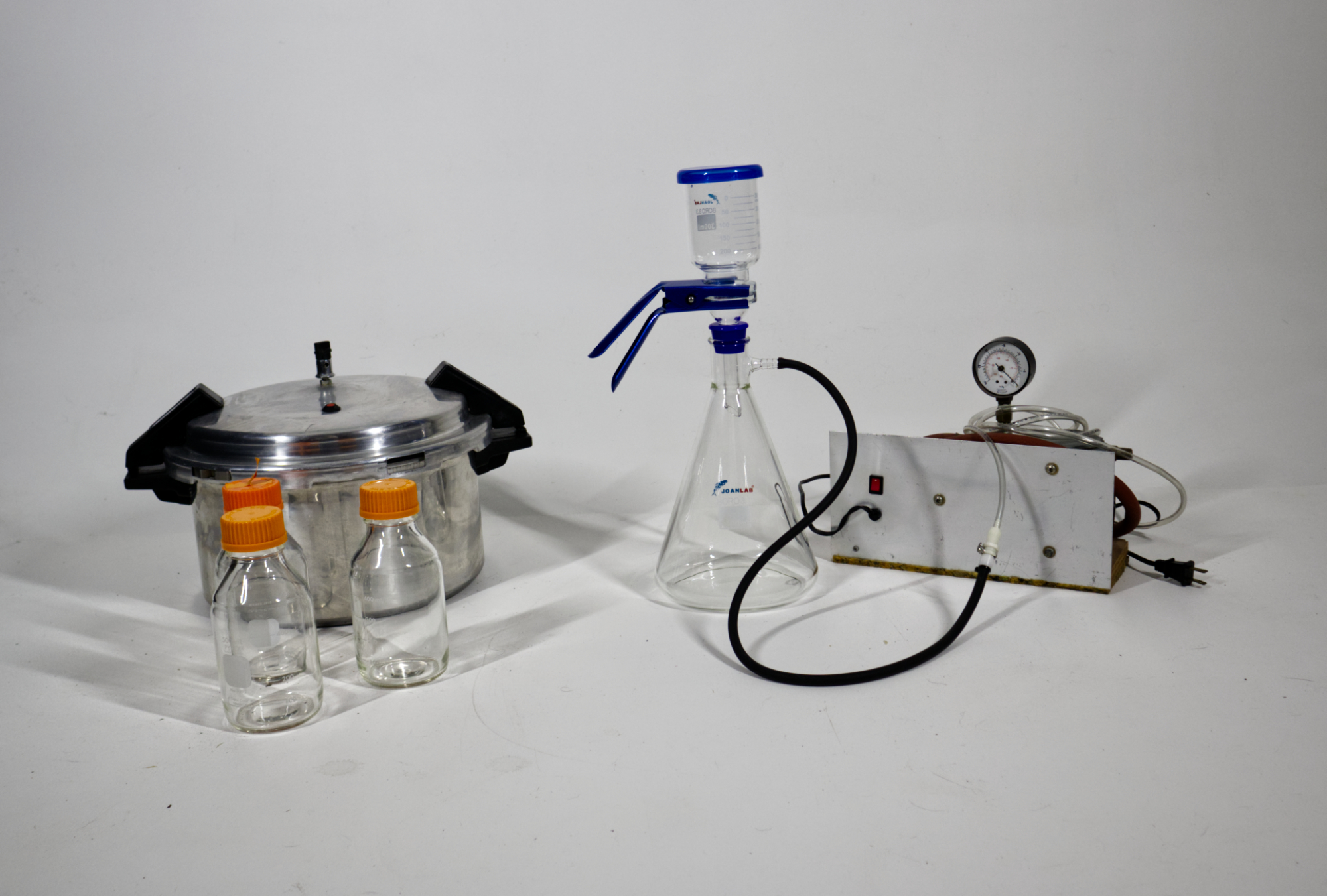
I’ll be using two vacuum filter apparatus with 20 micron filters that I’ll replace every 1000 mL.

Because my autoclave (pressure cooker) is only 8 inches high, I’m limited to four 500 mL bottles.

I plan on using the same pressure cooker to sterilize the soil I’ll collect to plant the seagrass rhyzomes in.

This is going to be so tedious!

Hobby: Water Sampling and analysis

Leave a comment

I made a series of instructional videos for a handful of Middle School students during the pandemic. I was told they were useful but I was never aske to make any more.

Hobby: Biology

Leave a comment

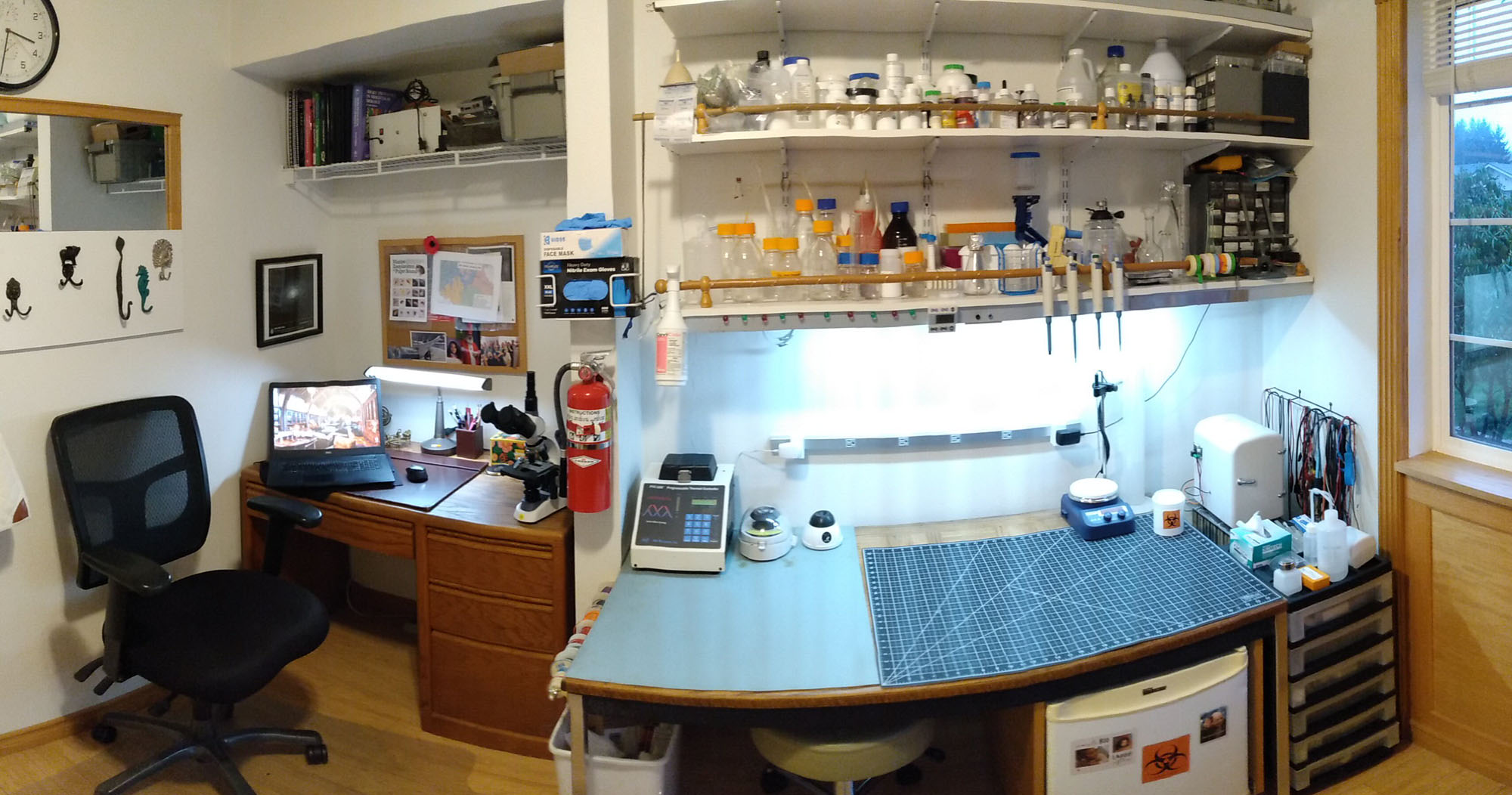
This is part of the BSL 1 lab I built in 2017 for learning Biology.

Since it’s completion, I’ve been growing safe strains of e.coli, running gels, mini-preps, PCR and other standard fare for learning basic biological methods.  I’m weak on the chemistry so there are a lot of Lewis diagrams in my notebook,  but I’m strong on bioinformatics so I enjoy it more and write about it less.

I figure that for every hour I spend seated on the lab stool in a lab coat, I spend 6 hours reading (and re-reading), 2 hours writing in my notebooks at the desk and another hour pounding my head against the white board trying to figure out why my experiments failed.

Hobby: Shakyou

Leave a comment

Shakyou is the zen meditation practice of writing the sutras out by hand.  For me, the meditation includes the feel and smell of grinding the ink and the feel of the limited interaction of brush with paper as I recite the sutra.

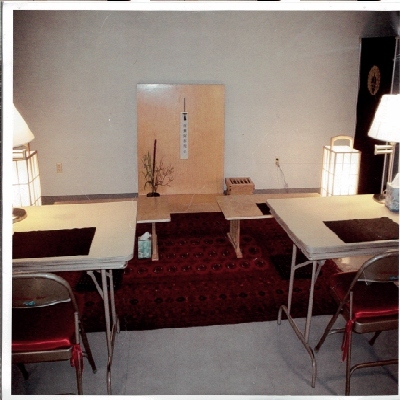
I spent the summer of 2shakyou007 building the floor lamps, altar, collection box and seiza tables you see here for the use in the Buddhist Church of Spokane, Washington.
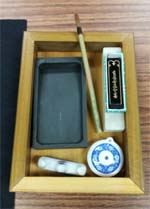
I bought ink suzuri stones, brushes, paper and other supplies for 18 seats and made fancy wooden boxes for each set.

When people entered, they were greeted with a warm, damp cloth to wipe their hands and face with and to sit by a hako niwa.

Each participant then picked their supplies from a table and sat down in a chair or on a zabuton to begin their meditation.shizuri_bako

Because this was done in a lunch area, the fluorescent overhead lamps and paraphernalia around the area were distractions.  I purchased table lamps for the tables and made traditional Japanese lamps for the seiza tables and turned off the overhead lights.

On the far right of the picture you can see a hanging curtain with the symbol for this church.  These were screen printed in gold on moleskin fabric and hung on rolling coat hangers. There was a wall of 6 alternating black and white curtains-on-rollers that walled this space off from the greeting area and the kitchen storage that was visible next to the space.

The carpets and runners I brought from home finished the space and completely converted the space from a lunch room into a magical space for meditation.

Hobby: Optics

Leave a comment

I only worked on optical systems that others had designed at Subaru Telescope, but while there I met Dr. Stephen Pompea of the National Optical Astronomy Observatory.  He had worked with Nishimura San of Subaru when they were both at U of Arizona and “Nishi” was always kind enough to take me along when he visited with other scientists from the mainland.

Dr. Pompea has always been an evangelist for teaching optics to pre-high school youth and in 2003 he got an NSF grant for “Hands-on optics” which gave teaching materials to grade school teachers in optics.  I was invited to participate in the inaugural class held at USC in 2003 and was able to teach it to a few of the home-schooled kids in Spokane, Washington.

The class provided a large notebook and a wide range of projects for us to teach with, but I went beyond the materials provided and built optical rails, and other “toys” for kids to take home to play with.

sam_0019


Hobby: Holography

Leave a comment

In the early 1960s Holography emerged as one of the most exotic uses of the unique light produced by lasers.  By the early 1970s it began to make the transition from scientist only to hobbyist.  At first it was to exploit it as an artistic medium but the amateurs that saw its potential quickly developed innovations of media and techniques that became main-stream.

By the mid 1990s the nascent “World Wide Web” had one or two Usenet newsgroups called alt.holography dedicated to the hobby.  Between this and a couple of “how-to” books published by the 1970s superstars of the San Francisco Holography Art movement everyone had access to the technology.

The hardware came available with affordable Kodak holography plates and the surplus lasers from copy machines made the hobby approachable to interested amateurs.  holo1

My holography table was built from the aft bulkhead of a 747 from Boeing Surplus which is a two-inch high honey-comb sandwiched between two aluminum sheets.  I added padding and bricks and placed it in my basement.

In the configuration seen in the pictures it is making a reflection hologram of some plaster whales.  One beam illuminates the whales, while the other illuminates the plate at the far right.

As yholo2ou can see, this is all stuff hacked together from scraps.


Hobby: Rocketry

Leave a comment

The 1990’s was a wonderful time to be a hobbyist.

The contagious optimism of that time lent itself well to the enthusiasms of people happiest when immersed in new technology..

One of the hobbies that decade “launched” was high power rocketry.  There were always two reactions the first time anyone ever saw a launch of anything bigger than the “Estes”rockets you could buy at any hobby store:  Awe and fear that you could do more than take someone’s eye out.  To assuage such fears, the hobby community itself, the US rocketsFederal Aviation Administration and the Bureau of Alcohol, Tobacco and Firearms provided strict regulations around the storage, purchase and use of any rocket motors with a specific impulse above 36 Lb-seconds.  In order to better assure that the hobbyist would align with these regulations, hobbyists associations coordinate the launches and supply amateurs with the supplies and training they need.

In 1996 I passed my level 1 certification and my level 2 in 1997.  In order to be certified to level 3 (allowing launch of rockets with a specific impulse exceeding 1,150 Lb-seconds) it was traditional to build something novel into the design.  In those days before cell phones and micro-power electronics the favorite was altimeter-based parachute deployment.

EricalchMine was a pic-based system with a clunky altimeter and an enormous T-1 accelerometer but what I really wanted to study was what’s called the mach disks of the rocket’s exhaust.  This is actually a phenomena that reveals volumes about the sonics, plasma and nozzles of all jet and rocket propulsion.

It is a fateful wind

Leave a comment

It is a fateful wind that blows in clear-cut forests

No bending branches no white-noise chorus

The kind of whispers that raise goosebumps

Like hushed vespers said over rotting stumps

The musky-sweet smell of the forest’s decay

A pungent censer for crows as they pray.

The wind feeds clouds born of barren landforms

They scour the earth with hail and thunderstorms

They reach up till the Heavens yell “Stop!”

But the lightning strikes out at the thunderhead’s top

It’s saying  “From Hell’s heart I stab at thee!”

Assailing the temple of deity.

The memory of psithurisms is an old man’s delight

Of walks in the woods on trails of dappled sunlight.

Through the trees that were the definition of ancient.

Their dancing leaves lent cool air its subtle scent.

Now roof shakes, fire wood and detritus

are all that is left of what used to delight us

Woods that sang sonnets to our immortal soul

were put to good use and bent to our control

Now we are the trees and with every breath

we breath the methane of a forest’s death.

Just as we’ll be buried under forest leaves

The rest’ll be buried under what mankind leaves.

Older Entries